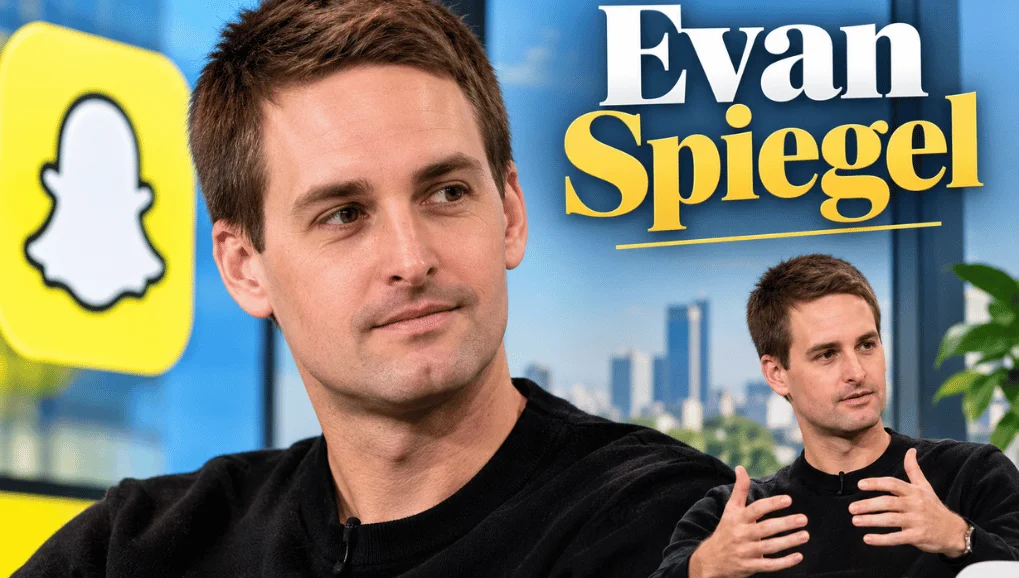
Evan Spiegel is the co-founder and chief executive officer of Snap Inc., the company behind Snapchat. He helped turn a Stanford student project into a major American technology business. Today, his focus increasingly extends beyond social media into augmented reality, artificial intelligence, and wearable computing.
Spiegel remains closely associated with Snapchat, but Snap’s ambitions have expanded considerably. The company introduced its SPECS augmented reality glasses in June 2026. That launch offers a useful window into where Spiegel believes personal computing could go next.
Quick answer: Evan Spiegel is an American technology entrepreneur who co-founded Snapchat and leads its parent company, Snap Inc. He has served as CEO since 2012. In 2026, his strategy centers on strengthening Snap’s advertising business while investing in augmented reality, AI, and the company’s SPECS wearable computer.
Evan Spiegel at a Glance
| Fact | Details |
|---|---|
| Full name | Evan Thomas Spiegel |
| Born | June 4, 1990 |
| Age in 2026 | 36 |
| Nationality | American |
| Known for | Co-founding Snapchat and Snap Inc. |
| Current role | Co-founder and CEO of Snap Inc. |
| Education | B.S. in Engineering, Product Design, Stanford University |
| Spouse | Miranda Kerr |
| Industry | Technology and social media |
| Major current focus | Snapchat, advertising, AI, augmented reality, and SPECS |
| Estimated wealth | About $2.3 billion as of September 12, 2026, according to Forbes |
Who Is Evan Spiegel?
Spiegel is an American entrepreneur best known for creating Snapchat with fellow Stanford students. Snap’s official leadership information says he has served as CEO and a director since May 2012. He later completed a Stanford degree in engineering with a product design focus. His career is closely tied to the development of camera-based communication on smartphones. Snapchat became known for disappearing photos, video messages, Stories, and augmented reality features.
Social media has also reshaped communities around interests such as sports, as Newsprien’s look at online soccer culture illustrates. His role now involves more than maintaining Snapchat’s position among social platforms. Snap is trying to build new revenue sources while continuing substantial technology investments. Wearable augmented reality has become one of the clearest examples of that strategy.
From Stanford Project to Snapchat
Snapchat’s origins date to Spiegel’s years at Stanford University. He worked with Bobby Murphy and Reggie Brown on the early concept that developed into the disappearing-photo application. Spiegel and Murphy later became the figures most closely associated with building the company. The idea challenged a basic assumption about online sharing at the time.
Social networks generally encouraged users to create lasting profiles and permanent collections of posts. Snapchat instead made temporary communication central to its product identity. That difference helped the application develop a distinctive position in social media. Snap eventually became a public company, listing shares on the New York Stock Exchange in 2017. Spiegel continued leading the business after the transition from startup to publicly traded technology company.
How He Built His Fortune
Much of Spiegel’s wealth stems from his ownership stake in Snap. Forbes estimated his real-time net worth at about $2.3 billion on September 12, 2026. Such estimates can change quickly because publicly traded shares fluctuate in value. Forbes also notes that Spiegel became the world’s youngest billionaire at age 24 in 2015. His wealth subsequently moved sharply as Snap’s market valuation rose and fell.
Readers comparing how public figures build wealth can also see Newsprien’s Travis Scott net worth and business ventures profile. Snap’s ownership structure is also important when considering his position at the company. Forbes reports that Spiegel and co-founder Bobby Murphy hold special voting shares that provide substantial control. That structure gives the founders influence beyond the economic percentage represented by ordinary shares.
Evan Spiegel and Snap’s 2026 Business Strategy
Snap entered 2026 with a stronger emphasis on financial efficiency and profitable growth. The company reported fourth-quarter 2025 revenue of $1.716 billion, up 10% from the previous year. It also reported $206 million in free cash flow for that quarter. The company continued to grow in the first half of 2026. First-quarter revenue reached $1.529 billion, up 12% year over year.
Second-quarter revenue then reached $1.599 billion, a 19% increase from the same quarter a year earlier. Snap reported 971 million monthly active users for the second quarter of 2026. The company said it was improving advertising performance while expanding its direct revenue business. These priorities show how management is balancing existing products with longer-term technology investments.
SPECS and His Bet on Augmented Reality
SPECS may be the clearest example of Spiegel’s vision for Snap beyond conventional social media. Snap introduced the consumer device in June 2026 as see-through augmented reality glasses. The company opened U.S. pre-orders at $2,195 with a $200 refundable deposit. The glasses are designed to place digital experiences within a user’s physical surroundings.
Snap says the device can support AI assistance, productivity tools, entertainment, and shared experiences. The company expects to ship the product in the United States, the United Kingdom, and France in fall 2026. Spiegel has framed the project around making computing feel more connected to physical life.
In a June 2026 interview with Axios, he discussed SPECS as part of a move toward real-world social interaction. The strategy puts Snap in a growing competition around smart glasses and wearable computing.
Why SPECS Matters for Snap
Snap has spent years developing augmented reality technology rather than entering the category all at once. The company says it has invested across operating systems, optics, computer vision, developer tools, and display technology. It also says its work in this area has produced more than 7,000 patents. That investment makes the SPECS launch more than a single hardware product.
Snap is attempting to establish its own computing platform instead of relying entirely on smartphones. Success would give the company a larger role in how people interact with digital information. The challenge is that consumer wearable technology remains a competitive and uncertain category. A $2,195 starting price also places the first consumer SPECS far above ordinary eyewear.
Adoption will depend on whether buyers see enough practical value in augmented reality experiences.
Leadership Changes at Snap in 2026
Spiegel has also overseen several leadership changes while Snap pursues its current strategy. Doug Hott became chief financial officer in May 2026 after holding senior finance and strategy positions. Ronan Harris became chief commercial officer in September 2026. Harris now leads Snap’s global advertising sales and go-to-market organization.
Snap said Europe produced ten consecutive quarters of double-digit year-over-year revenue growth through the second quarter under his regional leadership. The company also said European revenue grew nearly 40% in the first half of 2026. Snap added former Beats president Luke Wood to its board in May 2026. His experience covers technology, products, consumer brands, and entertainment.
These appointments suggest Snap is strengthening both commercial execution and product expertise around its next growth phase.
Personal Life and Family
Spiegel was born on June 4, 1990, and grew up in the Los Angeles area. He married Australian model and businesswoman Miranda Kerr in 2017. According to a current Aspen Institute Economic Strategy Group biography, the family lives in Los Angeles. That biography lists four children in their household: Flynn, Hart, Myles, and Pierre. Flynn is Kerr’s son from her previous marriage to actor Orlando Bloom.
Spiegel and Kerr have generally maintained a more private family life than their public careers might suggest. His activities outside Snap also include philanthropy. The same biography says he established the Spiegel Family Fund in 2017. Its areas of support include arts, education, housing, and human rights.
Philanthropy and Los Angeles Projects
Spiegel’s philanthropic work has expanded beyond the family fund. He and Bobby Murphy created the Snap Foundation to support pathways into creative careers for underrepresented young people. The work is particularly connected to Los Angeles. Following the 2025 Los Angeles wildfires, Spiegel also co-founded the Department of Angels. The nonprofit supports residents affected by the fires as they recover.
His Aspen Institute biography also describes a long-term environmental and public health research effort called the LA Fire HEALTH Study. These projects connect his public activities with the region where he grew up and built Snap. They also broaden his profile beyond technology and corporate leadership.
Readers interested in how prominent figures combine careers with charitable initiatives can compare this with Newsprien’s Molly Ephraim’s career and personal-life profile.
What Comes Next for Spiegel and Snap?
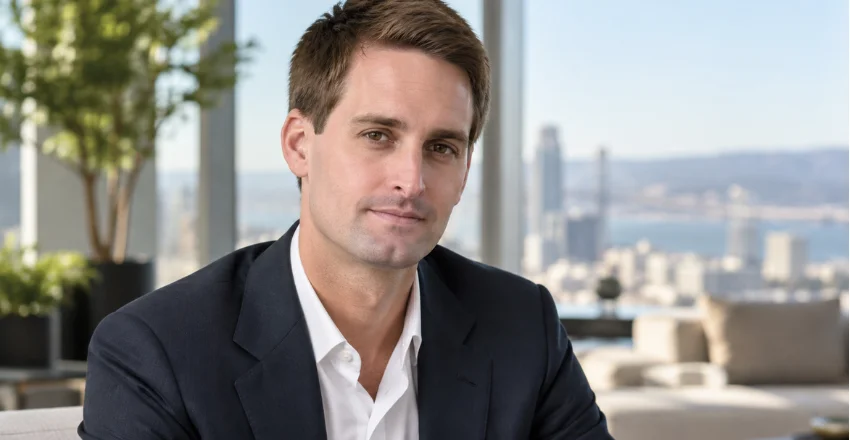
The next stage of Spiegel’s career will likely be shaped by two connected challenges. Snap must continue improving the economics of its established advertising and subscription businesses. At the same time, the company is spending on a different vision of personal computing. SPECS therefore represents both a product launch and a strategic test. Strong adoption could give Snap a position in wearable computing that is less dependent on smartphone platforms.
Limited adoption could increase pressure to focus resources on Snapchat and its existing revenue engines. Snap’s 2026 financial performance gives management more room to pursue that strategy than weaker growth would provide. Yet hardware, augmented reality, and AI remain expensive fields with major competitors. The balance between financial discipline and long-term investment will remain central to Snap’s direction.
The Bigger Picture
Spiegel’s career began with a simple challenge to how social media worked. Temporary photos and camera-first communication helped Snapchat establish a distinct identity. More than a decade later, he is making another large bet on how people could use computers. Whether augmented reality glasses become mainstream remains uncertain.
Snap’s SPECS project makes its position clear: the company wants to help define that future rather than watch from the sidelines. For Spiegel, the next chapter may depend on turning that technical ambition into products consumers use every day.
Frequently Asked Questions About Evan Spiegel
What is Evan Spiegel famous for?
Evan Spiegel is best known as the co-founder and CEO of Snap Inc., the parent company of Snapchat. He helped create Snapchat while studying at Stanford University. He has led Snap through its expansion, 2017 public listing, and current push into augmented reality hardware.
How old is he in 2026?
Spiegel was born on June 4, 1990. That makes him 36 years old as of September 2026. He became a billionaire while still in his twenties.
What is his net worth?
Forbes estimated his real-time net worth at approximately $2.3 billion on September 12, 2026. The figure can rise or fall alongside Snap shares and other assets. Net-worth estimates should therefore be read with their measurement date.
Is Evan Spiegel still the CEO of Snapchat?
He remains co-founder and CEO of Snap Inc., which owns Snapchat. Snap’s official leadership page lists him as chief executive officer in 2026. He has held the CEO position since May 2012.
Who is his wife?
Spiegel is married to Miranda Kerr, an Australian model and entrepreneur. The couple married in 2017 and lives in Los Angeles. Their household includes four children, according to the Aspen Institute Economic Strategy Group.
What is he working on now?
A major current focus is Snap’s SPECS augmented reality glasses. Snap introduced the consumer version in June 2026 and opened pre-orders in the United States. Spiegel is also overseeing efforts to grow advertising, direct revenue, free cash flow, and Snapchat’s global user base.